ENGINEERING · 2026-06-18
AI Generative Design & Topology Optimization: The 2026 Guide for Mechanical Engineers
AI generative design lets engineers describe a part's loads and constraints and have an algorithm produce hundreds of optimized, often organic-looking shapes — frequently 40–50% lighter than a human design. Here's how generative design and topology optimization actually work in 2026, the software that runs them, real weight-saving results, and how to bring them into your workflow without an enterprise budget.
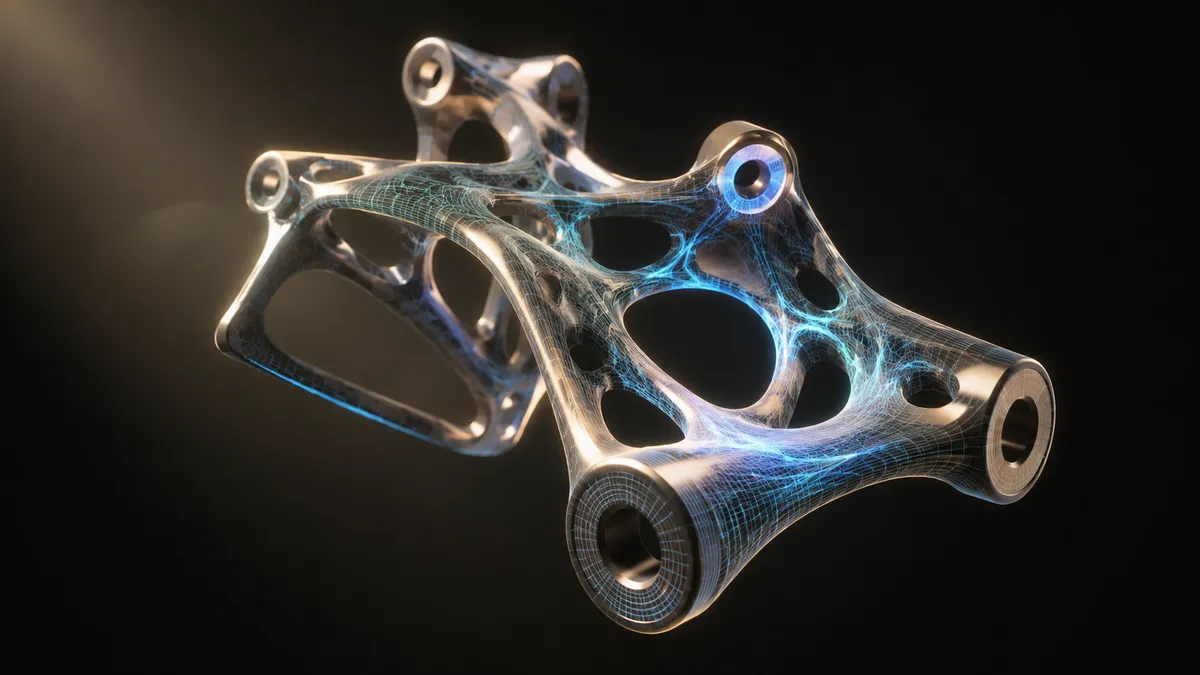
Generative design is an engineering method where you define a part's goals and constraints — loads, materials, keep-out zones, manufacturing method — and an AI-driven algorithm generates many optimized geometries that meet them, often shapes no human would draw by hand. It matters because those shapes are routinely 40–50% lighter than a conventionally designed part while meeting the same strength and stiffness targets, which is why it has become one of the fastest-growing skills in mechanical engineering in 2026.
Generative Design vs Topology Optimization: What's the Difference?
The two terms are often used interchangeably, but they are not the same thing. Topology optimization takes one existing design and removes material from it until only the load-bearing structure remains. Generative design is broader: it explores many distinct design candidates from scratch, across different materials and manufacturing methods, and presents a range of validated options to choose from.
| Aspect | Traditional CAD Design | AI Generative Design |
|---|---|---|
| Starting point | Engineer draws a shape from experience | Engineer defines loads, constraints & goals |
| Options explored | One or two iterations | Hundreds of validated candidates |
| Typical weight | Baseline | 40–50% lighter for the same strength |
| Best manufacturing fit | Machining, casting | Additive manufacturing (3D printing) |
| Engineer's role | Create the geometry | Set the problem & judge the results |
How AI Generative Design Works — Step by Step
- Define the design space — the maximum volume the part can occupy, and the regions that must stay clear.
- Specify the loads and constraints — forces, pressures, fixtures, and safety factors the part must survive.
- Set the goals — minimize mass, maximize stiffness, or hit a target safety factor.
- Choose the manufacturing method — 3D printing, CNC milling, or casting, which shapes what geometry is allowed.
- Let the algorithm iterate — the solver runs hundreds of physics-based simulations and evolves the geometry.
- Review and validate — the engineer compares candidates and confirms the winner with independent FEA.
Notice that the engineer's judgment frames every step. The algorithm optimizes the problem you give it — define the loads wrong and you get a confident, lightweight, wrong answer. That is exactly why the validation step matters, and where my FEA and simulation services come in: a generative result is only trustworthy once it has been checked against first principles.
Real Results: How Much Lighter, Really?
The headline numbers are real and well documented. General Motors, in a 2018 project with Autodesk, redesigned a seat-belt bracket that ended up 40% lighter and 20% stronger while consolidating eight separate components into a single printed part. Airbus's 'bionic partition' for the A320 cabin, generated with the same class of algorithm, was around 45% lighter than the original — a saving that, fleet-wide, translates into thousands of tonnes of fuel per year.
Traditional design asks 'what shape should this part be?' Generative design asks 'what does physics want this part to be?' — and the answers rarely look man-made.
How to Bring Generative Design Into Your Workflow
- Pick one high-value part — ideally something heavy, expensive, or fatigue-critical where weight savings pay off.
- Rebuild it as a generative problem — capture the real loads and constraints, not just the current shape.
- Run it in accessible software — Autodesk Fusion 360, nTop, ANSYS Discovery, or SolidWorks all offer it now.
- Validate the winner with independent FEA before committing to tooling or print.
- Design for the chosen process — generative shapes usually assume additive manufacturing, so confirm printability.
You don't need an enterprise license to start — a single critical bracket, modelled properly and validated, is enough to prove the value. This is precisely the kind of cross-domain work I take on: the CAD modelling in SolidWorks, the generative setup, and the ANSYS-grade FEA validation that turns an algorithm's suggestion into a part you can actually manufacture and defend. If you have a component that's heavier than it needs to be, it's very likely a generative-design candidate.
Frequently Asked Questions
What is generative design in mechanical engineering?
Generative design is a method where an engineer defines a part's loads, materials, and constraints, and an AI-driven algorithm produces many optimized geometries that satisfy them. It is used to create parts that are significantly lighter and stronger than conventional designs, especially for 3D printing.
What is the difference between generative design and topology optimization?
Topology optimization removes material from one existing design until only the load-bearing structure remains. Generative design is broader — it generates many new design candidates from scratch across different materials and manufacturing methods, then presents validated options to choose from.
Which software is used for generative design in 2026?
The most widely used tools are Autodesk Fusion 360, nTopology (nTop), ANSYS Discovery, and SolidWorks, all of which now include generative design or topology optimization features accessible to individual engineers and small firms.
How much weight can generative design save?
Real-world projects typically achieve 40–50% weight reduction for the same strength. For example, a General Motors seat-belt bracket was made 40% lighter and 20% stronger, and Airbus's bionic cabin partition was about 45% lighter than the original.
Is generative design only useful for 3D printing?
Generative results are best suited to additive manufacturing because the organic shapes are hard to machine or cast, but the algorithms can also be constrained to milling or casting rules to produce designs that are manufacturable with conventional methods.